
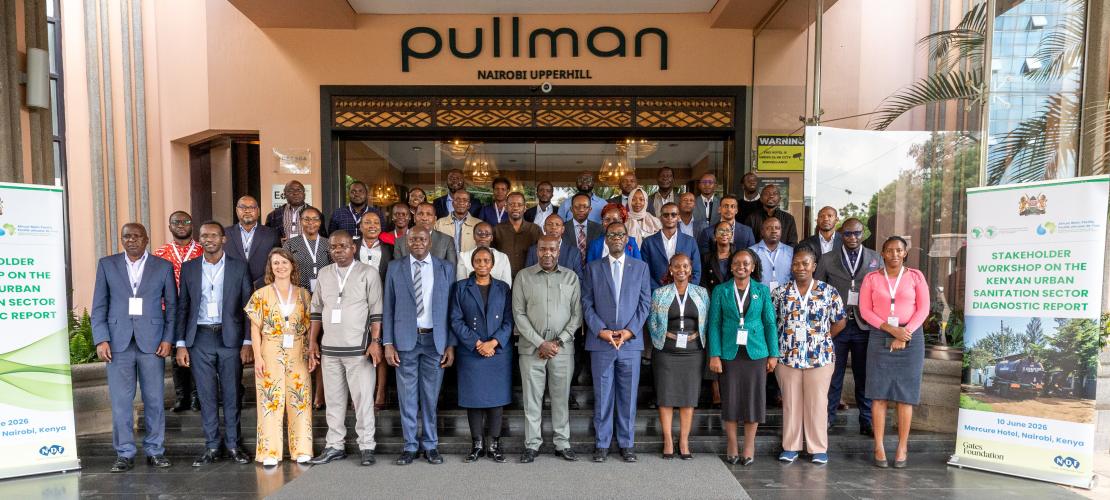
The African Development Bank, through the African Water Facility, launched the Kenya urban sanitation diagnostic report during a stakeholder workshop presided over by Julius Korir, the Principal Secretary of the State Department Water and Sanitation State Department in the Kenya’s Ministry of Water, Sanitation and Irrigation and Dr Alex Mubiru, the Director General of the East Africa Regional Development and Business Delivery Office (RDGE) based in Kenya for the African Development Bank.
The event brought together a wide range of stakeholders including senior representatives from the Kenya’s Ministry of Water, Sanitation and Irrigation, development partners, regional water works development agencies, water service providers, the civil society, commercial banks, and other private sector stakeholders.
The Kenya urban sanitation diagnostic study was conducted under the Africa Urban Sanitation Investment Initiative (AUSII) as a part of a regional effort to analyze the urban sanitation in a first group of 12 countries on sanitation structural challenges, institutional arrangements, investment gaps, market opportunities and priority interventions for the urban sanitation in selected African countries. The evidence-based studies aim to kick-start urban sanitation operations, because the sector’s enormous challenges require bold action.
The workshop discussed findings of the diagnostic report and how to translate its recommendations into an urban sanitation investment program. Major results of the Kenya sanitation diagnosis were presented, including investment needs and potential financing pathways - grants, guarantees and private public partnerships, and requirements for technical assistance.
The meeting explored the programmatic approach that will enable the Government of Kenya to implement a multiyear investment programme with systematic interventions in the urban sanitation sector by different financing partners. This is expected to produce more impactful, sustainable, high-level sanitation services.
Alex Mubiru highlighted that “sewerage cannot cover the sanitation needs of the population; on-site sanitation service provision will have to cover a substantial part of the sanitation needs. This means another way of thinking, a more flexible, adaptive way to provide services with people involved. This will lead to more sustainable solutions”, he said.
“Local banks are expected to play an important role in financing the sector in collaboration with development partners which could offer dedicated financial instruments to promote private sector involvement in the sanitation sector”, he added.
This sanitation diagnostic report calls for mobilization to invest in urban sanitation at a substantially higher level. The report estimates the value of the sanitation market to grow from $1.28 billion in 2025 to approximately $3 billion by 2050. The private sector is expected to play an important role in achieving this growth.
In his opening address, Julius Korir said that “the new Kenya sanitation policy opens up new avenues for collaboration in public private partnership and commercial financing of sanitation, adoption and integration of new technologies, developing sanitation research agenda, improving sector coordination, and sanitation monitoring, reporting and evaluation”. “The Kenya country diagnostic report, whose findings are going to be presented here today, provides good insights on the nation’s urban sanitation landscape and the potential for reaching new frontiers in accelerating access to urban sanitation services”, he added.
The Government of Kenya is committed to strengthening a public‑private partnership to speed up the urban sanitation investments with improved policy and regulations that may unlock the long‑term capital and risk‑sharing and expanding the use of innovative and promising private‑led models that exist in containment and emptying.
The Director of Sanitation Management in the Ministry of Water, Sanitation and Irrigation, Engineer Mary Wamaitha, indicated that the Government of Kenya is aligned with a programmatic approach of the sanitation sector under the leadership of the Government and other development partners through an action plan structured to bring impactful interventions. The government is committed to bringing the sector to a more sustainable growth path with more people covered in smaller cities and peri-urban areas, and with better services provided. Concluding the workshop, she called the workshop participants to prioritize sanitation and asserted that the workshop was a success. ‘’Let us put sanitation in our heart’’, she said.
AUSII is a flagship initiative of the African Water Facility (AWF), managed by the African Development Bank (AfDB), and supported by the Gates Foundation and the Nordic Development Fund. The initiative is designed to unlock and scale up investments in urban sanitation across Africa by supporting the preparation of bankable projects. AUSII will also operate investment financing with concessional and blended finance and guarantees to anchor investment in the urban sanitation sector.