
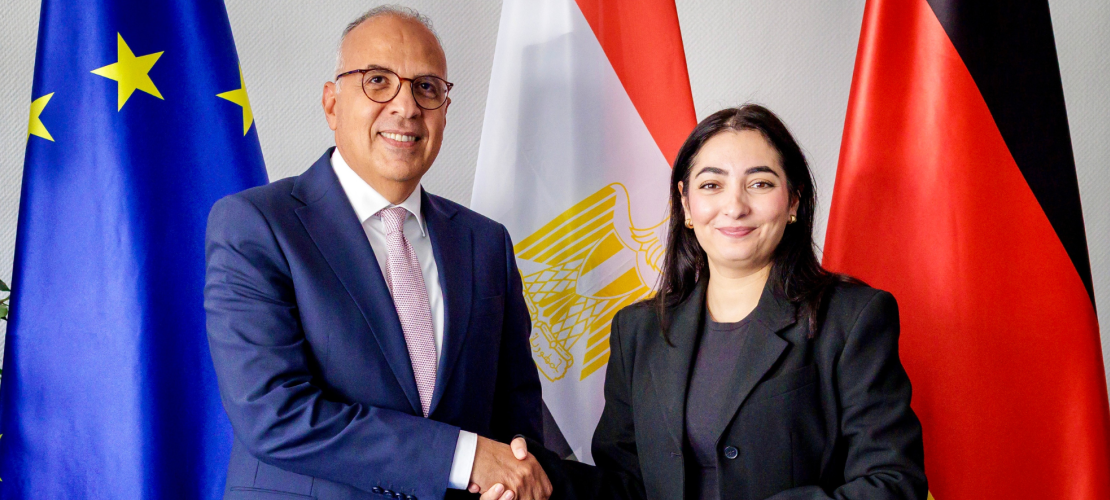
The African Water Facility and the German Government are moving to deepen their strategic partnership, with discussions focused on supporting implementation of the AWF Strategy 2026–2030 and mobilising greater financing, expertise and investment for Africa’s water security priorities.
The high-level engagement took place in Germany between H.E. Prof. Dr Hani Sewilam, Egypt’s Minister of Water Resources and Irrigation and Chair of the Governing Council of the African Water Facility (AWF), and H.E. Reem Alabali-Radovan, Germany’s Federal Minister for Economic Cooperation and Development.
Mtchera Johannes Chirwa, Director of the Water Development and Sanitation Department at the African Development Bank, participated in the meeting alongside H.E. Ambassador Mohamed El Badri, Ambassador of the Arab Republic of Egypt to Germany, and officials from AWF and the Bank.
The discussions centred on building a long-term institutional partnership capable of reinforcing AWF’s continental role in preparing water and sanitation investments and mobilising the resources required to move them forward.
They also explored how Germany’s development cooperation architecture, including institutions such as KfW Development Bank and the Deutsche Gesellschaft für Internationale Zusammenarbeit (GIZ), could align with AWF’s strategic priorities over the 2026–2030 period.
Prof. Dr Sewilam said bringing these capabilities together could create new opportunities for African water investments.
“Combining the capabilities and expertise of German institutions with AWF’s role in project preparation will create broader opportunities to finance and implement Africa’s water security priorities,” he said.
Chirwa said the engagement comes at an important moment for the Facility as it implements its new five-year Strategy.
“Our ambition under the 2026–2030 Strategy is not simply to prepare more projects, but to prepare stronger projects that can attract investment and move towards implementation,” he said. “A deeper partnership with the German Government can strengthen our ability to do that at scale and respond to the priorities being brought forward by African countries.”
A strategic partnership around Africa’s water investment agenda
The African Water Facility, an initiative of the African Ministers’ Council on Water, administered by the African Development Bank, occupies a critical position between countries’ water priorities and the investments needed to address them.
AWF finances the preparatory work that allows priority projects to progress from an identified need into credible investment propositions. This includes feasibility studies, technical designs, environmental and financial assessments and other activities necessary to establish whether projects are technically viable and ready to attract financing.
Under its Strategy 2026–2030, the Facility is strengthening this role while placing greater emphasis on mobilising investment around the projects it prepares.
The Strategy responds to priorities spanning water supply and sanitation, climate resilience, productive water use and stronger water institutions, while reinforcing AWF’s role as a continental mechanism capable of building a stronger pipeline of investments.
The discussions in Germany therefore focused not simply on individual projects, but on how a major development partner could engage with AWF at a strategic level to help advance this broader agenda.
Prof. Dr Sewilam said the ministerial engagement represented an important step towards establishing that longer-term relationship.
“Securing German support through a ministerial pledge to the African Water Facility represents a significant step in my role as Chair of the AWF Governing Council and lays the foundation for a strong, long-term partnership between AWF and Germany,” he said.
Bringing Germany’s development capabilities behind the AWF Strategy
Germany is an established development partner in Africa and a contributor to both the African Development Bank and the African Development Fund.
The meeting examined how that relationship could be extended through stronger cooperation with AWF, drawing on German development finance, technical cooperation, technology and private-sector expertise.
Particular attention was given to potential engagement by KfW Development Bank and GIZ, alongside opportunities to draw on German expertise in drinking water, sanitation, water treatment, utility performance and related areas.
The German Federal Minister for Economic Cooperation and Development expressed Germany’s interest in continuing its cooperation with AWF and in drawing on German expertise and technologies to support the continent’s water sector.
The discussions also highlighted the alignment between Germany’s development priorities and the AWF Strategy, particularly around water security, climate resilience, investment mobilisation, strategic partnerships and increased private-sector participation.
According to Chirwa, the potential partnership is particularly significant because it could bring several complementary forms of support around projects originating from African countries.
“What makes this partnership important is the possibility of bringing different instruments together around one African-led investment pipeline,” he said. “AWF can prepare the projects, while development finance institutions, technical partners and the private sector can engage around opportunities already grounded in countries’ priorities. That is the kind of partnership architecture Africa’s water sector needs.”
From partnership to continental impact
The two sides agreed to continue technical discussions to define priority areas and modalities of cooperation and examine how German support could contribute to implementation of the AWF Strategy 2026–2030.
The engagement strengthens AWF’s effort to build a broader coalition of governments, development finance institutions, technical partners and private investors around Africa’s water investment needs.
For the Facility, this is central to the ambition of its new Strategy.
Increasing investment in Africa’s water security requires more than identifying needs. It requires credible projects, sustained project preparation resources, strong financing partnerships and institutions capable of carrying investments through to implementation.
A deeper partnership between AWF and the German Government would bring these elements closer together around an African-led platform already working with countries to develop their priority investments.
For communities, that larger institutional architecture ultimately has a practical purpose: enabling more essential water and sanitation investments to move from national priorities and project concepts towards financed infrastructure and services on the ground.