
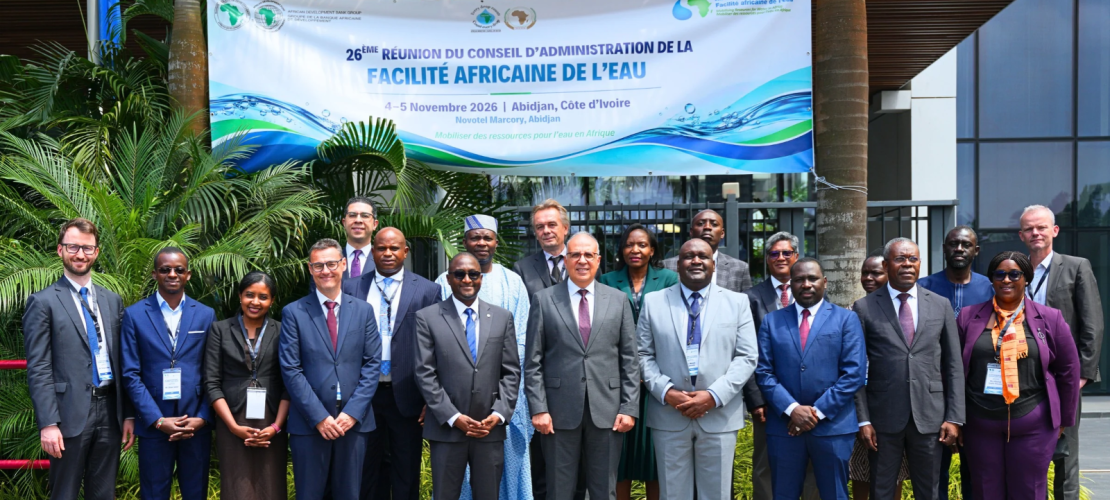
The African Water Facility Governing Council has approved its 2027 Work Plan and Budget, setting new priorities for project delivery and resource mobilisation across Africa. The Council also agreed to launch studies and consultations on possible reforms to strengthen the Facility's long-term operations.
The decisions were taken during the 26th Governing Council meeting, held on 4 and 5 November 2026 in Abidjan, Côte d'Ivoire, under the chairmanship of H.E. Prof. Dr Hani Sewilam, Egypt's Minister of Water Resources and Irrigation and Chair of the AWF Governing Council.
The meeting brought together representatives of African governments, the African Development Bank, the African Ministers' Council on Water (AMCOW) and development partners to review AWF's progress and agree on its priorities for the coming year.
Opening the meeting, Professor Sewilam called for stronger action to turn Africa's water and sanitation ambitions into investments that improve people's lives.
"Our task is to turn this vision into projects, and projects into investment and services for our people," he said, referring to the Africa Water Vision 2063, adopted by the African Union.
Greater focus on delivering projects in 2027
Under the approved Work Plan, AWF expects to manage more than 40 projects in 2027, with greater attention to completing ongoing activities and preparing new investments that can attract financing.
The Facility plans to approve four to five new projects, complete ten ongoing projects, including six under the Sahel and Horn of Africa Programme, and disburse EUR 8 million to support implementation.
Mtchera Johannes Chirwa, Director of the African Development Bank's Water Development and Sanitation Department, said the Facility must balance its ambitions with available resources.
"In 2027, we will choose quality over quantity, and we will make resource mobilization our priority, so that the Facility can continue to prepare the projects Africa needs," Chirwa said.
The new priorities form part of AWF's 2026–2030 Strategy, which aims to strengthen the preparation of water and sanitation projects and attract more investment across the continent.
Building on two decades of results
Professor Sewilam highlighted AWF's achievements over the past two decades, noting that the Facility has supported 153 projects in 54 African countries through approximately EUR 240 million in grants.
These investments have contributed to improved access to water for 50.1 million people and sanitation for 22.4 million people. AWF-supported project preparation has also helped mobilise USD 4.19 billion in additional financing.
During the first nine months of 2026, the Facility disbursed EUR 9.1 million and continued preparing new projects. Its 2026 Call for Proposals attracted 650 applications, reflecting strong demand for support across Africa.
Professor Sewilam also highlighted progress in building new partnerships, including engagement with Germany, and called for greater African contributions to the Facility alongside continued international support.
Council agrees to examine operating model reforms
In another important decision, the Governing Council endorsed the launch of studies and consultations on possible reforms to AWF's operating model.
The aim is to explore ways to improve the Facility's financial sustainability and strengthen its ability to support African countries.
In his closing remarks, Professor Sewilam stressed that any changes must preserve AWF's development mandate and respond to the needs of the countries it serves.
He also made clear that the Council had not approved specific reform measures. Any proposals arising from the studies and consultations must return to the Governing Council for further consideration and approval before implementation.
Stronger partnerships and financing
Funding remained a major focus of the meeting, which followed the AWF Donors & Observers Meeting held on 3 November in Abidjan.
Development partners discussed the Facility's achievements, progress under its 2026–2030 Strategy and the resources needed to sustain its operations.
AWF aims to mobilise EUR 18 million in core funding and USD 30 million for its African Urban Sanitation Investment Initiative (AUSII) in 2027.
The Council also reviewed progress under AUSII and AWF-financed projects in Burkina Faso and Somalia.
Professor Sewilam emphasised the importance of continued cooperation between African governments, development partners and the African Development Bank to ensure that AWF has the resources needed to deliver its mandate.
Turning commitments into results
Closing the two-day meeting, Professor Sewilam thanked Council members and partners for their contributions and called for continued action to implement the decisions taken in Abidjan.
"As we look ahead to 2027, our collective priority must be to turn strategic commitments into effective institutional action and tangible results on the ground," he said.
The meeting concluded with a planned visit to the La Mé Drinking Water Treatment Plant near Abidjan.
The decisions taken at the 26th Governing Council will guide AWF's work in 2027 as it seeks to deliver ongoing projects, prepare new investments and mobilise the financing needed to improve water and sanitation services across Africa.