
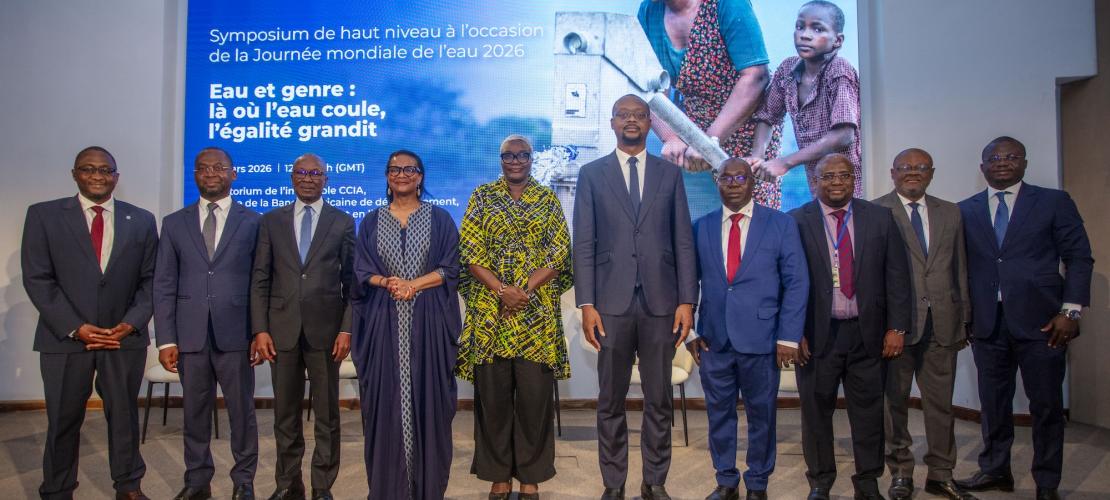
The African Development Bank celebrated the World Water Day 2026 in the auditorium Room of the Bank. This year’s World Water Day focused on water and gender with the motto: “Where Water Flows, Equality Grows.”
The Bank’s symposium discussed the importance of water and gender development and also explored the global urgency of providing access to safe water for women and girls especially in urban areas. The symposium gathered the Bank’s water partners including representatives of the private and public sectors institutions, international organizations, the civil society, the media, the academia, higher education schoolers and the Bank’s staff.
Giving his welcome remarks, Mtchera J. Chirwa, Director of the Water Development and Sanitation Department at the African Development Bank said that the Bank is committed to turning the Africa Union’s Water Vision under Agenda 2063 into reality. The African Development Bank is making a tangible water infrastructure in investing over $ 6 billion across more than 40 countries.
“Our investments aim to create a water secure environment for all and to ensure that these services are inclusive, climate-resilient, and responsive to the needs of everyone especially women and girls”, he said. “Because when water flows closer to home, something remarkable happens. Time is returned, opportunities expand, and equality begins to take root. But we must go further”, he added.
The African Water Facility was established the Bank to facilitate resource mobilization and address the huge investment gap of water infrastructure development. Since 2019, the Bank spearheaded the creation of the Africa Urban Sanitation Investment Initiative (AUSII) recognizing the importance of dedicated financing for urban sanitation in Africa through the African Water Facility with support from Bill and Melinda Gates foundation.
AUSII increases the scale and impact of investments in urban sanitation services in Africa, by creating an enabling environment and a variety of financing options, tailored to the needs of the recipient countries, for efficient and sustainable investments from development and commercial finance institutions. AUSII is piloting urban sanitation projects in seven countries – Uganda, Kenya, Zambia, Ghana, Mauritania, Cote d’Ivoire and Togo with a focus on inclusive on-site sanitation, faecal sludge management, development of sanitation masterplans and investment planning at a cost of $ 8.4 million in developing bankable projects and catalytic investments
Marie-Laure Akin-Olugbade, Senior Vice President of the African Development Bank Group said in her keynote address, that the Bank is striving to build an eco-friendly, inclusive economy that tackles water security and other key priorities.
“The theme of water and gender is more than a simple affirmation; it reflects the hardships of our continent. In Africa, women and girls carry the burden of collecting, managing and protecting water resources in their households and their communities. Yet, they remain affected by the lack of secure and sustainable water”, she said.
The celebration entertained remarkable discussions on water and gender development by water and sanitation partners including the Director of Water Coordination Center at ECOWAS, Alexis Kouassi, the CEO of Eranove, Bakayovo Ahmadou and the Director General Hydraulic - Ministry for Hydraulic, Sanitation, and Hygiene, Cote d’Ivoire, Djramado Yao Paul. The panel also discussed respective actions conducted by the private and public sectors in response to offer water accessibility and security to African communities.
The lyrical artist performed a recital on water and gender; and their message urged the audience and water decision makers to transpire the water security and gender equality into reality. The artists’ team brought musical mood and captivating ambiance using the African traditional music instruments.
In her conclusive remarks, Dr. Jemimah Njuki, Director Gender, Women and Civil Society at the African Development Bank said that women entrepreneurs face an estimated $ 42 billion financing gap that directly affects their ability to scale water-related enterprises, from irrigation services to small-scale distribution and processing.
“Because time spent collecting water is time taken away from education, from income-generating activities, from leadership, and from rest, it entrenches what we call time poverty, and it reinforces cycles of inequality across generations”, she said. “This is why today’s theme — ‘Where water flows, equality grows’ — is not just a slogan. It is a call to action. And yet, what we have also heard today is a message of possibility”, she added.
The Bank’s Water Department ensures that water security and sanitation address the Bank’s four cardinal points, CP#1 on partnerships and enhanced access to capital, and CP#4 on the development of climate-resilient infrastructures. It also manages the implementation of the Bank Ten-Year Strategy and remains consistent with the African Water Facility (AWF) Strategic Action Plan 2026–2030, driving the Bank’s commitment to advancing transformative sanitation governance.