
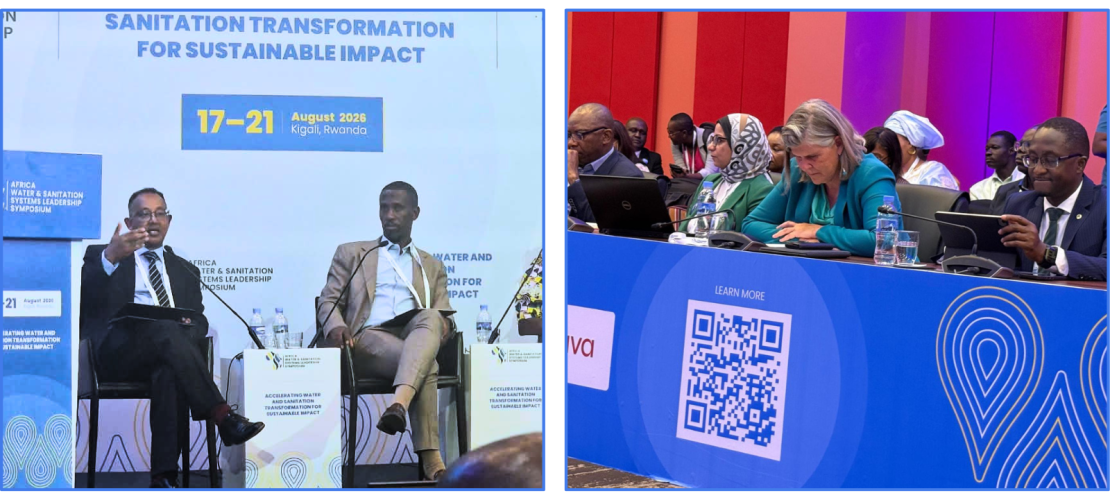
Mtchera Chirwa and Mecuria Assefaw set out how targeted reforms, accountable management and financially stronger utilities can improve services and create better conditions for investment
Better-performing institutions, financially sustainable utilities and reforms designed around clearly identified problems dominated African Development Bank interventions at the Africa Water and Sanitation Systems Leadership Symposium in Kigali.
Across two high-level discussions, Bank officials examined the institutional conditions that determine whether water and sanitation providers can deliver reliable services, sustain their infrastructure and attract the investment required to expand.
Mtchera Chirwa, Director of the African Development Bank’s Water Development and Sanitation Department, opened the Bank’s engagement by calling on governments and sector institutions to be clear about what they expect reform to accomplish.
“The question that I’d like to pose is: why are we doing reforms at all?” Chirwa said during the high-level dialogue on Building High-Performing, Accountable and Investment-Ready Water and Sanitation Services. “Reforms are to improve performance and achieve better results and sustainability.”
The session brought Chirwa together with ministers and senior representatives from Rwanda, Uganda, Nigeria, Mali and Ghana, alongside AUDA-NEPAD, UNICEF, AMCOW, the Kingdom of the Netherlands and other sector partners.
Reform must respond to the institution
Chirwa cautioned against applying identical reform programmes across countries.
“Reforms vary country to country, setting to setting. It’s not the same reforms that everybody should be doing at the same time,” he said.
Countries, he explained, should first analyse the obstacles preventing their institutions from achieving the results expected of them and then develop a reform roadmap suited to their governance arrangements, institutional responsibilities and operating environment.
The desired outcome is clear: high-performing institutions capable of delivering reliable and predictable services.
Chirwa identified professional management and staffing, performance-based contracts, asset maintenance plans and capital investment planning among the elements required to improve institutional performance.
Financial sustainability, he said, is equally important.
Water and sanitation institutions need stronger revenue systems and predictable tariff arrangements that allow them to sustain services while protecting vulnerable consumers. He also pointed to the potential for differentiated tariffs, with users employing water for profit-generating activities contributing more and helping support lower-income customers.
His intervention placed accountability, service performance and financial sustainability within the same reform agenda.
Stronger utilities can open the door to more capital
In a second session, Mecuria Assefaw, Manager of the African Development Bank’s Water Development and Sanitation Division covering Eastern and Southern Africa, carried the discussion into the financing challenge facing urban utilities.
Assefaw participated in D4.1 – Professionalising Urban Water Utilities: Accelerating Financial Credibility, Effectiveness and Investment Readiness, alongside utility and sector representatives from Uganda, Rwanda, Kenya and Ghana, the World Bank, International Water Association and VEI Water Operator Partnerships.
Responding to a question on how African utilities can reduce their reliance on sovereign guarantees and gain greater access to financing on the strength of their own balance sheets, Assefaw focused on the role of development finance institutions in helping countries build stronger utilities.
“The role of DFIs, including the African Development Bank, is not only to finance projects, but also to help create sound and sustainable institutions,” Assefaw said. “Through the Sustainable Water Utilities Transformation initiative, the Bank will assist utilities to create a pathway that progressively builds performance, creditworthiness and investment readiness.”
Stronger and more viable utilities, he posited, give private capital greater confidence to enter the sector and help finance investment needs.
Assefaw explained that the Bank’s utility transformation approach supports utilities through three broad stages: assessing their readiness, developing a transformation plan and providing assistance across financing and related areas.
The readiness assessment examines the conditions that influence a utility’s capacity to perform and attract finance. These include governance and regulation, legal and policy frameworks, operational performance, infrastructure investment requirements, cost-recovery mechanisms, financial planning and management, human resources and institutional capacity.
Utilities enter that process at different levels of readiness. The assessment provides a basis for identifying the constraints affecting each institution and determining the reforms and investments required to strengthen its operational and financial position.
Investment readiness starts inside institutions
Taken together, the two Bank interventions placed institutional performance at the heart of the investment-readiness discussion.
Chirwa focused on the purpose and design of reform: countries need to identify their own constraints, define the performance they want and develop realistic pathways to achieve it.
Assefaw addressed the next part of the equation: helping utilities establish the governance, operational and financial strength needed to mobilise larger pools of capital.
The discussions also connect with African Development Bank Group President Sidi Ould Tah’s Four Cardinal Points, particularly the priority of Unlocking Africa’s Capital. President Ould Tah has identified mobilising more capital at lower cost as one of the Bank’s strategic directions, alongside stronger African financial systems and resilient infrastructure.
In the water and sanitation sector, that objective depends in part on institutions capable of preparing investments, managing infrastructure, generating sustainable revenues and giving financing partners confidence that capital can be deployed effectively.
The Africa Water and Sanitation Systems Leadership Symposium runs from 17 to 21 August 2026 at the Kigali Convention Centre.